Home / Why EOM

EOM vs the field

One platform built for how environmental and energy commodities actually trade — multi-vertical, venue-native and AI-ready. Here's how Emsurge Open Markets stacks up against the two ways the market is usually served: central exchanges and procurement platforms.

Three approaches, three philosophies

Where each approach really sits

Emsurge

EOM

OTC-native trading & venue platform

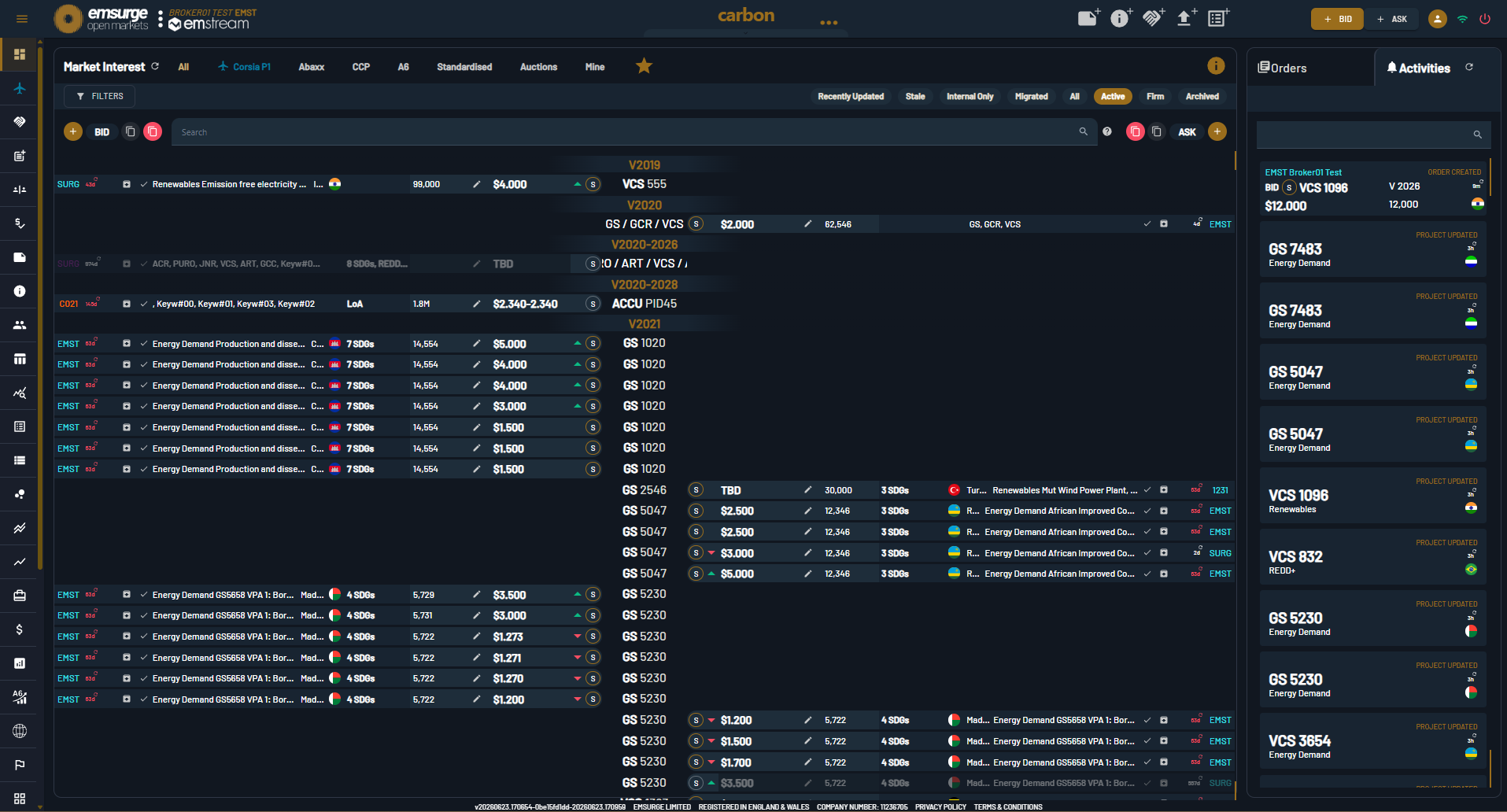
Indicative order discovery, venues, white-label marketplaces and live AI/MCP access — across Carbon, LNG, EAC and Biodiversity.

Central exchanges

Click-and-trade order books

Centralised spot exchanges for standardised contracts, often paired with brokerage and registry services. Institutional and broad — but built on a click-and-trade model the market has been slow to adopt.

Procurement platforms

Carbon sourcing & intelligence

RFP-based sourcing, due-diligence and market intelligence for corporate carbon buyers. Typically carbon-only, and not a trading venue.

At a glance

The differences that matter most

CapabilityEOMCentral exchangesProcurement platforms
Multi-vertical coverage Carbon · LNG · EAC · Biodiversity Carbon plus adjacent certificates Typically carbon only
Trading model fit for today's market OTC indicative-first — matches how the market really transacts Exchange / click-and-trade — elegant, but thin real-world adoption RFP procurement, not live trading
AI / MCP agent access Live MCP server — query your market from Claude None we're aware of None we're aware of
Venues & cross-venue Aggregator Yes — replaces portfolio spreadsheets Single central exchange No
White-label marketplaces Yes — your storefront, your price & volume rules White-label registries only No
Built for brokers, traders & developers alike Yes — all segments, one platform Institutional traders / brokers Primarily corporate buyers

Where EOM wins outright

Four advantages, no asterisks

Multi-commodity, not carbon-only

Carbon, LNG, EAC and Biodiversity on one platform. Most alternatives stop at carbon; EOM follows the value across energy and environmental markets — including LNG.

OTC-indicative-first — built for reality

Most environmental credits trade bilaterally, not on a screen. EOM's indicative-order model mirrors how brokers and traders actually negotiate, instead of forcing a click-and-trade workflow onto a market that hasn't adopted it.

Agent-native via MCP

EOM ships a live Model Context Protocol server: customers query prices, orders and projects directly from an AI assistant like Claude. No other major carbon trading platform offers anything comparable.5 And your data stays yours — never shared with any other service; the assistant sees only what your own account can see.

Your own venue, not just an order book

Venues plus a cross-venue Aggregator give traders and project developers a direct replacement for portfolio spreadsheets — with transaction, fee and invoice tracking built in.

The "exchange liquidity" question

Built for the market as it is

The central-exchange pitch rests on one claim: deep, liquid order books. The public market data tells a more sober story — and explains why EOM's OTC-first approach fits better.

A small, OTC-dominated market — by the numbers

$535M1
Total value of the entire voluntary carbon market in 2024 — down 29% year-on-year
3 yrs1
Consecutive annual declines in VCM value, now back to 2020 levels
Most2
of voluntary carbon credits trade over-the-counter, not on exchange
  • The whole market is modest and contracting. Reported VCM transaction value fell to roughly $535M in 2024, with volume down 25% to about 84.4 MtCO₂e — a third straight year of decline.1 A central order book in a market this size cannot offer the depth the word "liquidity" usually implies.
  • Exchanges are the minority channel. Most voluntary carbon credits trade OTC; exchanges handle standardised contracts, while real projects are heterogeneous and negotiated bilaterally.23
  • Headline "records" are episodic. Exchange volume spikes have tended to cluster around COP weeks rather than reflecting sustained daily depth.4
  • Buyers value the bespoke product. In 2022, OTC prices rose while exchange-traded prices fell — evidence that buyers will pay for negotiated, project-specific deals an exchange can't represent.3

Bottom line: click-and-trade is the theoretically tidy model, but in a small, heterogeneous, OTC-driven market it isn't how participants transact. EOM is engineered for the market as it is.

Full comparison

Feature by feature

CapabilityEOM (Emsurge)Central exchangesProcurement platforms
Primary trading modelOTC indicative orders + private venuesCentral spot exchange (firm order book)RFP-based procurement
Asset classesCarbon · LNG · EAC · BiodiversityCarbon plus adjacent certificates and commoditiesTypically carbon (VCM) only
Live price discoveryYes — live order prices, tiered accessYes — exchange bookBenchmarks & curves, not a live book
Brokerage / structured dealsYes — broker-native workflowsOften — via affiliated brokerage armsAdvisory-led
Venues / multi-tenantYes — Venues + AggregatorSingle central exchangeNo
White-label marketplacesYes — price & volume rulesWhite-label registry services at mostNo
Procurement / RFQRFQs via MarketplacesExchange RFQYes — core strength
Portfolio / position managementYes — Venues + AggregatorOften — portfolio toolsPost-purchase tracking
Registry connectivityRegistry Insights (read)Strong — some operators own registriesGenerally no
Market intelligence & reportingYes — Projects/Orders reports, chartsYes — data products incl. third-party ratingsYes — core strength
Historical data & APIYes — 2021– data + API accessYes — data subscriptionsLimited
AI / MCP agent accessYes — live MCP server5None we're aware ofNone we're aware of
Transaction, fee & invoice trackingYes — built inVia portfolio toolsPost-purchase only
Target customersTraders, developers, brokers, consultants, corporatesInstitutional traders / brokersCorporate buyers

Strength / fully supported Partial / different approach Not offered

Sources & legal

References

The market figures cited above are drawn from the following public sources. Figures are as reported by those sources and rounded for readability.

  1. Ecosystem Marketplace, State of the Voluntary Carbon Market 2025 — "SOVCM 2025 Finds the Voluntary Carbon Market in Transition" (May 2025). ecosystemmarketplace.com
  2. Deloitte UK, Understanding the Compliance and Voluntary Carbon Trading Markets (2023). deloitte.com
  3. Ecosystem Marketplace / World Bank — "Carbon Markets Resilient in a High-Pressure 2022" (OTC vs exchange pricing). ecosystemmarketplace.com · Carbon Market Watch, FAQ: the financial workings of the VCM (2024). carbonmarketwatch.org
  4. Exchange operators' public trading-volume reporting and industry press coverage of record trading days around COP weeks (accessed June 2026).
  5. Descriptions of the platform categories — including the observation that no other major carbon trading platform advertises native AI / MCP agent access — are based on the public product materials of the leading platforms in each category, accessed June 2026. "Major carbon trading platform" refers to the leading platforms by market presence in the voluntary carbon market; we make no claim about every platform in existence.

Important notice & disclaimer

Scope of comparison. Emsurge Open Markets (EOM) is a product of emsurge limited. This page compares EOM with categories of alternative — central exchanges and procurement platforms — not with any named company or product. Any third-party names or trademarks referenced in the sources are the property of their respective owners, and no affiliation or endorsement is implied.

Basis of comparison. Statements about the platform categories are honest comparative statements of opinion and fact, generalised from information leading providers in each category have made publicly available, together with the independent third-party sources cited above, each accessed in June 2026. Individual providers vary, and products, features and market conditions change over time. We have taken reasonable care to compare like with like, but category-level comparisons necessarily simplify. Where a capability is shown as "partial" or "not offered", this reflects our reasonable interpretation of publicly available information at the time of writing, not a definitive statement about any specific provider.

"No other major carbon trading platform" claims. Where we state that a capability (such as native AI / MCP access) is offered by no other major carbon trading platform, this reflects our review of the leading platforms' publicly available product materials as of June 2026 and is our honest opinion on that basis. "Major" refers to leading platforms by presence in the voluntary carbon market; it is not a guarantee about every platform in the market, and the position may change over time.

No warranty. This page is provided for general information on an "as is" basis. To the fullest extent permitted by law, emsurge limited makes no representations or warranties, express or implied, as to the accuracy, completeness or currency of the information, including any third-party data, and accepts no liability for any loss or damage arising from reliance on it.

Not advice. Nothing on this page constitutes financial, investment, legal, tax or trading advice, an offer, a solicitation, or a recommendation to buy or sell any instrument or product. Market data relating to the voluntary carbon market is provided by third parties and is indicative only.

Corrections. We aim to be accurate and fair. If you believe anything on this page is inaccurate or out of date, please contact legal@emsurge.com and we will review and, where appropriate, promptly correct it.

Comparison prepared by emsurge limited, June 2026.

See it on your market

The comparison is one thing — the platform is another. Tell us your vertical and your problem, and we'll show you EOM built around it.

Book a walkthrough